Lasting Longer: How Selective Dorsal Neurectomy and Frenulectomy Treat Premature Ejaculation
Selective dorsal neurectomy (SDN) and frenulectomy are the two surgical options for premature ejaculation driven by an over-sensitive penis. This guide sets out what the research actually shows, what results look like in practice, what can go wrong, and who should not have it.
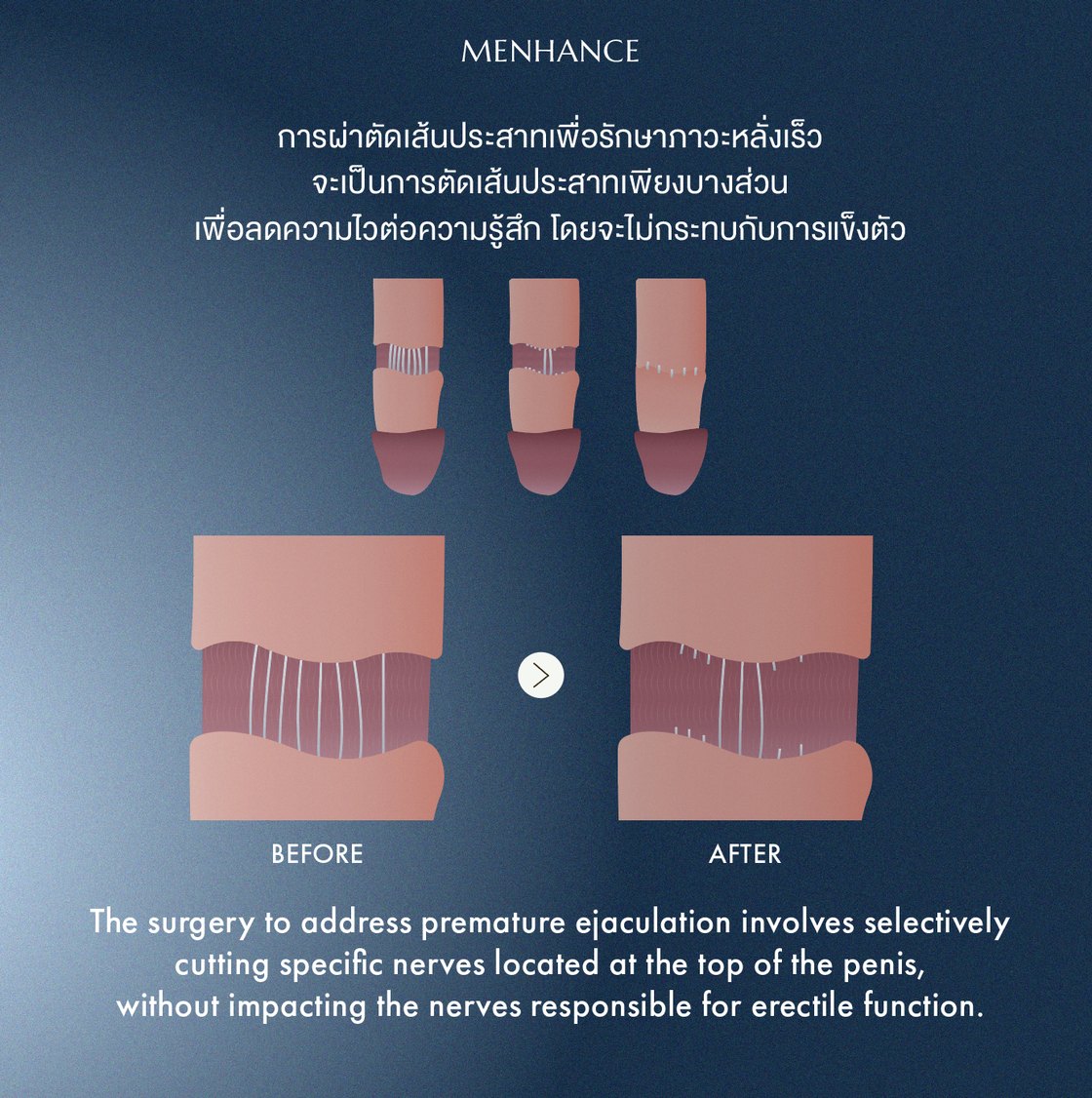
Selective dorsal neurectomy (SDN) and frenulectomy are the two surgical options for premature ejaculation driven by an over-sensitive penis. SDN divides selected sensory branches of the dorsal penile nerves while preserving the nerves that drive erections. Frenulectomy removes the frenulum, one of the most densely innervated parts of the penis. At MENHANCE they are usually performed together, for men who have not improved with medication, creams or behavioural work.
Surgery for premature ejaculation is the most debated area of men’s sexual health, and you deserve to know that before you read anything else. This article sets out what the published research actually shows, what the results look like in practice, what can go wrong, and who should not have it.
Key takeaways
- It is considered experimental. The AUA and SMSNA classify surgery for premature ejaculation as experimental, and the EAU and ISSM do not recommend dorsal neurectomy. It is still widely performed in Asia for men who have run out of other options.
- The reported gains are real but variable. A 2025 meta-analysis of 235 men found SDN increased ejaculation latency by about 147 seconds on average, with better control and satisfaction and no significant change in erectile function. Frenulectomy alone added about 2.5 minutes in the main published study.
- It is not risk-free or guaranteed. Roughly 11% of men in pooled data report an adverse event, premature ejaculation returns in about 10%, and dividing a nerve cannot be undone.
Where SDN Sits in the Evidence
Surgery is the most contested option in premature ejaculation care, so it is worth being clear about where the major guidelines stand before anything else.
| Body | Position on surgery for premature ejaculation |
|---|---|
| AUA / SMSNA (United States) | Surgical management should be considered experimental and used only within an ethics board-approved clinical trial |
| EAU (Europe) | Recommends against dorsal neurectomy, because more safety data are needed |
| ISSM (International) | Does not recommend surgical treatment, citing possible permanent loss of sexual function and insufficient reliable data |
| Practice in Asia | Use has grown for men who do not respond to medical treatment, with reports of efficacy and rare sensory loss |
Publishing that table on a clinic’s own website is unusual. We think you should see it, because an honest decision needs the case against as well as the case for. A urologist’s job is to tell you where the evidence is strong, where it is thin, and what that means for you specifically.
The Two Procedures, and Why They Are Done Together
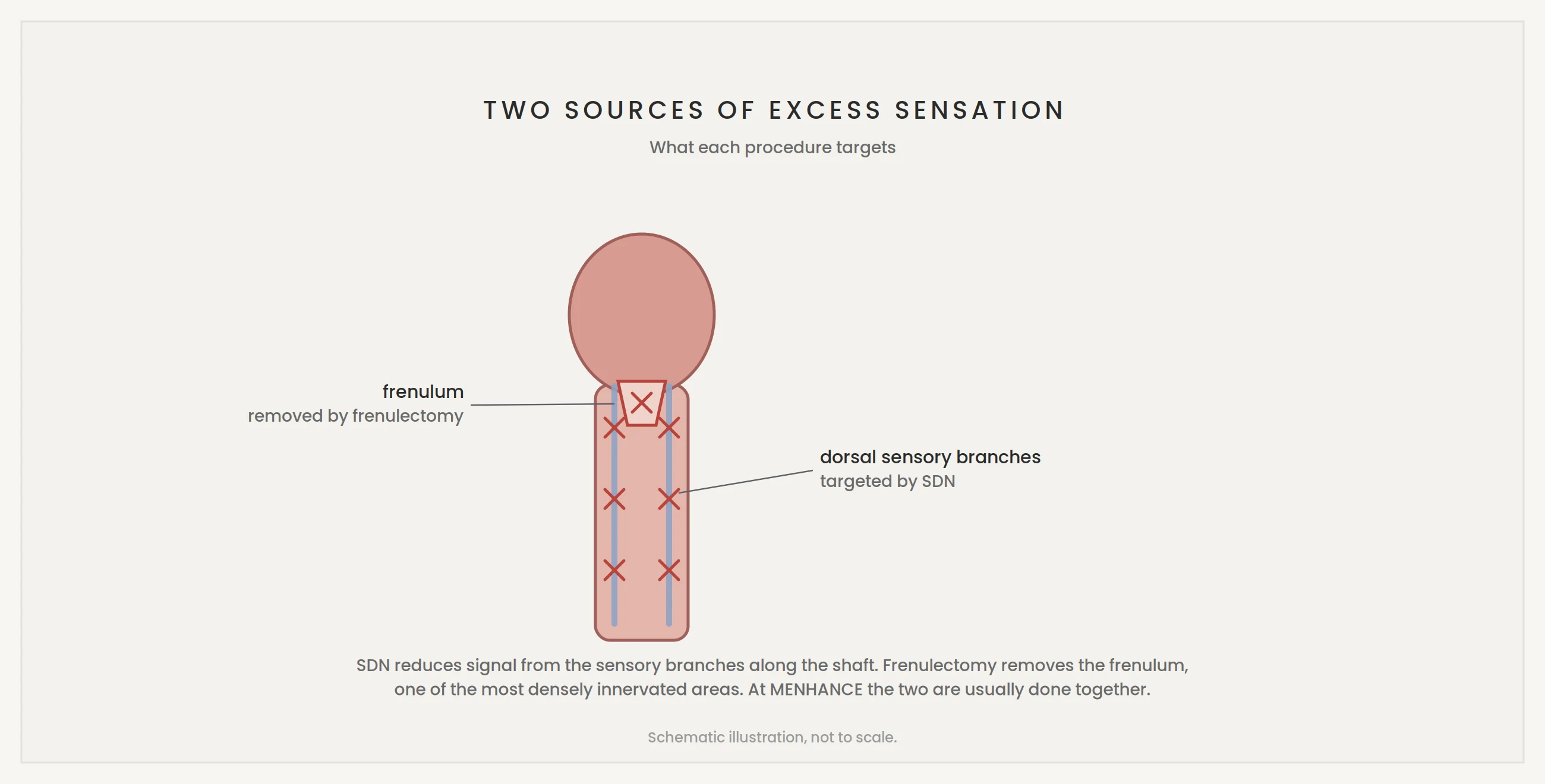
Sensitivity does not come from one place. The dorsal nerves carry sensation along the shaft and into the glans, while the frenulum, the small band on the underside of the head, is one of the most densely innervated areas of the penis. Treating only one of the two leaves the other intact.
| Selective dorsal neurectomy | Frenulectomy | |
|---|---|---|
| What it does | Divides selected sensory branches of the dorsal nerves | Removes the frenulum |
| Target | Sensory signal along the shaft and glans | A concentrated area of nerve endings under the head |
| Aim | Raise the threshold for the ejaculatory reflex | Remove a hypersensitive trigger point |
| Reversible? | No — divided nerves cannot be reattached | No — removed tissue cannot be replaced |
Two separate sources of excess sensation, addressed in one operation. One thing to be clear about: the published evidence covers each procedure separately. We found no trial of SDN and frenulectomy performed together, so combining them is a clinical judgement built on the evidence for each part, not an approach that has been tested as a combination. Anyone who tells you otherwise is overstating what exists.
Frenulectomy is not the same as frenuloplasty
The two sound alike and do opposite things. Frenulectomy removes the frenulum to reduce sensation. Frenuloplasty releases and lengthens it while preserving it, which is the right operation for a frenulum that pulls, hurts or tears during sex, and it is designed to keep sensation intact. If pain and tearing are your problem rather than timing, read our guide to frenuloplasty for a tight frenulum instead.
What the frenulum evidence shows
The most cited study found a short frenulum in 59 of 137 men (43%) presenting with lifelong premature ejaculation. After frenulectomy, mean ejaculation latency rose from 1.65 minutes to 4.11 minutes, an increase of 2.46 minutes, with no surgical complications over a mean follow-up of 7.3 months.
That study had no control group and short follow-up, and a critical review concluded there is not enough evidence on safety and efficacy to recommend frenulum surgery as a treatment for premature ejaculation. As with SDN, the honest position is that the signal is real and the evidence is thin.
The Reasoning Behind SDN
For some men, premature ejaculation is not about anxiety or technique. The ejaculatory reflex is triggered by sensory input, and if the glans sends too much signal too quickly, the threshold is reached sooner than you can control.
There is anatomical evidence for this. A randomised controlled trial in men with lifelong premature ejaculation found that their dorsal penile nerve branches were more numerous and thicker than in men without the condition, and that SDN improved ejaculation latency and ejaculatory control, with few postoperative complications. Men with premature ejaculation have also been shown to have lower penile vibration thresholds, meaning a heightened sensory response.
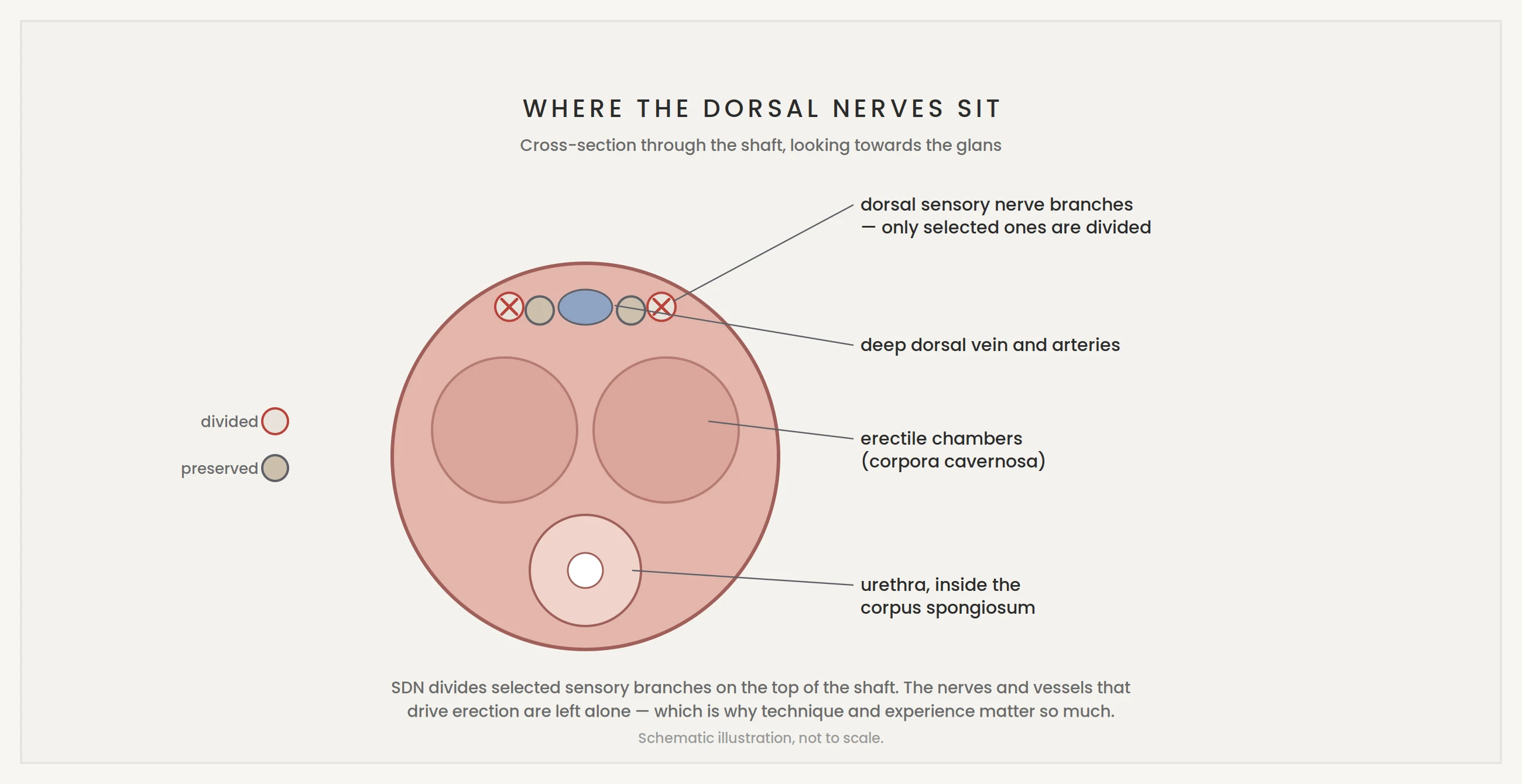
The word that matters is selective. The aim is to remove some of the excess signal, not the sensation itself. How many branches are divided, and which ones are left, is the difference between better control and a complication.
What Results Actually Look Like
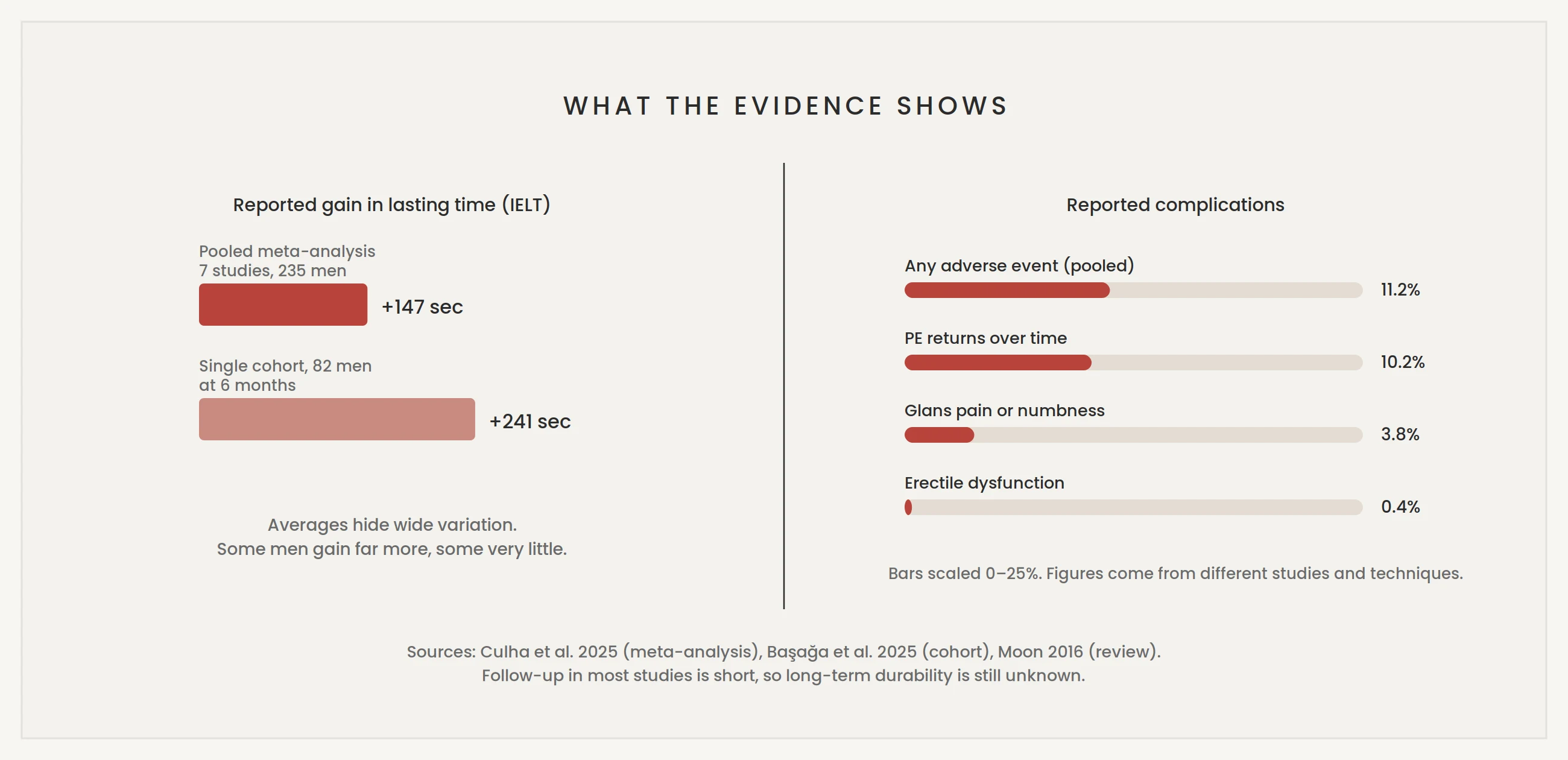
The best summary of the evidence is a 2025 systematic review and meta-analysis in The Journal of Sexual Medicine. Seven studies covering 235 men met the inclusion criteria. Pooled results showed a significant improvement in ejaculation latency of about 147 seconds, alongside better scores for ejaculatory control and sexual satisfaction. Erectile function did not change significantly. The adverse event rate was 11.17%. The authors noted that the studies were heterogeneous with short follow-up, and called for standard protocols and longer follow-up.
Individual series report larger gains. In a 2025 retrospective cohort of 82 men with lifelong premature ejaculation, treated with a nerve-sparing technique, mean latency rose by 241 seconds at six months, a 559% increase, with no major complications including glans numbness or anorgasmia.
Why averages are the wrong way to think about this
An average of two and a half minutes across a group tells you very little about your own result. Some men gain far more, and some gain very little. Baseline matters: a man starting at 30 seconds and a man starting at two minutes are not the same case. Anatomy varies, technique varies between surgeons, and most published follow-up runs only to six or twelve months.
MENHANCE describes a typical outcome as a 3 to 5 times increase over your baseline lasting time, for example around 1.5 minutes extending to roughly 4.5 to 7.5 minutes once healed. That sits within the published range, but it is a typical result rather than a promise, and no clinic can guarantee your number.
The Risks, Stated Plainly
Nerve surgery is not reversible. These are the complications reported in the literature:
- Premature ejaculation returns: around 10% in published review data, since divided nerves can regenerate
- Pain or altered sensation on the glans: around 4%
- Erectile dysfunction: well under 1%, but reported
- Numbness or difficulty reaching orgasm: linked to more aggressive resection rather than nerve-sparing technique
- Transient sensory loss: Korean series have reported overall complication rates of 10–12%, including this
- Traumatic neuroma: a painless nodule from nerve regrowth, described in a case report years after surgery
- Standard surgical risks: bleeding, infection, swelling and bruising
- Frenulectomy risks: bleeding from the frenular artery, scarring at the site, and a permanent reduction in sensation in that area, which is the intended effect but cannot be reversed
The pattern across these studies is consistent: outcomes depend heavily on how conservatively the surgery is done. The cohort that preserved small branches reported no numbness, while series with more aggressive resection reported sensory loss. This is a procedure where the surgeon matters more than the brochure.
What to Try First
Every guideline puts non-surgical treatment first, and so do we. Depending on your pattern of premature ejaculation, that means:
- Behavioural and psychosexual work, particularly where anxiety, a new relationship or performance pressure plays a part
- Topical anaesthetics, applied before sex to reduce glans sensitivity temporarily
- SSRIs, either daily or on demand, including dapoxetine where available
- PDE5 inhibitors, alone or combined, particularly if erections are also inconsistent
- Treating what else is going on, including erectile difficulties, thyroid or testosterone problems, or prostatitis
See premature ejaculation treatment for the non-surgical options we offer. If erections are part of the picture, ED treatment should be addressed first, because treating the erection problem alone sometimes resolves the timing problem. And if the frenulum is tight or tears during sex, frenuloplasty may be relevant to you instead.
Who SDN Suits, and Who It Doesn’t
It may be appropriate if
- Your premature ejaculation is lifelong and linked to a highly sensitive glans or frenulum
- You have properly tried non-surgical treatment without enough improvement
- Your erections are reliable, or any erectile problem has been assessed
- You understand the result is a large improvement in timing, not a guarantee
It is not the right choice if
- The problem is clearly situational, tied to anxiety, a specific partner or a new relationship
- Your premature ejaculation is recent and the underlying cause has not been investigated
- You have untreated erectile dysfunction, an active genital infection or an untreated skin condition
- You have not yet tried first-line treatment, or you want surgery as a first step
- You are expecting a specific number, or a permanent result nothing can change
A consultation that ends in “this is not for you” is a good outcome, not a wasted trip. Being turned down for the right reason protects you from an irreversible procedure that was never going to solve your problem.
Questions Worth Asking Any Clinic
- Is the technique nerve-sparing, and how many branches do you typically divide?
- Is the procedure performed with magnification, and by whom?
- What proportion of your patients report no useful improvement?
- What happens if my premature ejaculation returns, and what does that cost?
- What is the follow-up, and how do I reach the surgeon afterwards?
- Will you tell me if I am not a good candidate?
If a clinic answers those with marketing language rather than numbers, that tells you something.
SDN at MENHANCE
About the surgeon
Dr. Teanchai Siricharoensang (“Dr. Chai”) · Board-certified urologist · Thai medical licence No. 14396
30 years’ experience in urology, including 13 years at Samitivej Hospital. MD from Siriraj Medical School. Member of the Thai and American Urological Associations. He performs SDN himself in an on-site sterile operating room, using a surgical microscope and headlight, and follows up with every patient directly on WhatsApp after surgery. Meet our doctors
The procedure and recovery
- Assessment first: we confirm that hypersensitivity is the driver, review your history and rule out other causes
- Non-surgical options first: SDN is considered when those have not given enough improvement
- Outpatient surgery under local anaesthetic in a fully equipped operating room, using a circumferential desensitisation technique with magnification, with frenulectomy performed in the same session where appropriate
- Home the same day, with wound healing typically over 1 to 2 weeks
- No strenuous activity or sex for 3 to 4 weeks
- A review within 72 hours is strongly recommended, with WhatsApp access to your surgeon afterwards
Selective dorsal neurectomy at MENHANCE is ฿65,000, available at our clinics in Bangkok (RQ49 Mall, Sukhumvit 49), Phuket (Boat Galleria, Choeng Thale) and Pattaya.
Ready to talk it through?
- Book a free, confidential consultation — including an honest answer on whether SDN is right for you.
- Message the team on WhatsApp at +66 97 168 4448.
- International patients can start with an online consultation.
Frequently Asked Questions
What is selective dorsal neurectomy?
Selective dorsal neurectomy (SDN) is a microsurgical procedure for premature ejaculation driven by an over-sensitive glans. The surgeon divides selected sensory branches of the dorsal penile nerves to reduce excess sensation, while preserving the nerves responsible for erections. At MENHANCE it is an outpatient procedure under local anaesthetic.
Does selective dorsal neurectomy actually work?
Published studies report longer ejaculation times after SDN. A 2025 systematic review and meta-analysis of 7 studies and 235 men found a mean increase in ejaculation latency of about 147 seconds, with better reported ejaculatory control and satisfaction and no significant change in erectile function. The studies varied widely and follow-up was short, so results in any individual man cannot be guaranteed.
Is SDN approved by international guidelines?
No. The AUA and SMSNA guidelines classify surgery for premature ejaculation as experimental, and the EAU and ISSM guidelines do not recommend dorsal neurectomy, citing a need for more safety data. It is nevertheless offered in several Asian countries for men who have not responded to medical treatment, and it is your right to be told this before deciding.
Why is frenulectomy done at the same time as SDN?
They address different sources of the same problem. SDN reduces sensory signal from the dorsal nerves along the shaft, while frenulectomy removes the frenulum, a concentrated area of nerve endings under the head. Treating one and leaving the other can limit the result. Note that published studies have assessed each procedure separately rather than the combination.
What is the difference between frenulectomy and frenuloplasty?
Frenulectomy removes the frenulum to reduce sensitivity, and is used in the treatment of premature ejaculation. Frenuloplasty releases and lengthens the frenulum while preserving it and its sensation, and is used for a tight frenulum that pulls, hurts or tears during sex. They have opposite aims.
Does removing the frenulum reduce sexual pleasure?
Reducing sensation in that area is the intended effect, and it cannot be reversed. In the main published study, men reported longer ejaculation times without reported complications, but this is a permanent change and should be discussed carefully before you agree to it.
Will SDN make me numb?
That is the main fear, and technique is what decides it. Nerve-sparing approaches that preserve small branches report no glans numbness or anorgasmia, while more aggressive resection has been linked to sensory loss. Across the literature, glans pain or altered sensation is reported in roughly 4% of men.
Can premature ejaculation come back after SDN?
Yes. Recurrence is the most commonly reported complication, at around 10% in published reviews, as divided nerves can regenerate over time. Any clinic describing the result as guaranteed or permanent is overstating the evidence.
Does SDN affect erections?
The technique is designed to preserve the nerves that drive erections. In the pooled analysis, erectile function scores did not change significantly, and erectile dysfunction has been reported in well under 1% of cases. Tell your surgeon if you already have erection problems, as these should be assessed first.
What should I try before considering surgery?
Behavioural techniques, psychosexual therapy, topical anaesthetics, daily or on-demand SSRIs such as dapoxetine, and in some men PDE5 inhibitors. Guidelines place these first, and surgery is considered only after they have been properly tried.
How long is recovery after SDN?
It is an outpatient procedure and you go home the same day. Wound healing typically takes 1 to 2 weeks, with any swelling or bruising usually minor. Avoid strenuous activity and sex for 3 to 4 weeks, and a review within 72 hours is strongly recommended.
How much does selective dorsal neurectomy cost in Thailand?
At MENHANCE, SDN is ฿65,000, performed by a senior urologist as a same-day procedure under local anaesthetic at the Bangkok, Phuket and Pattaya clinics.
References
- Culha MG, Erkoc M, Baran C, Ozcan L. Clinical efficacy and safety of selective dorsal neurectomy/cryoablation for treatment of premature ejaculation: systematic review and meta-analysis. J Sex Med. 2025;22(8):1383–1389. doi:10.1093/jsxmed/qdaf140
- Liu Q, Li S, Zhang Y, et al. Anatomic basis and clinical effect of selective dorsal neurectomy for patients with lifelong premature ejaculation: a randomized controlled trial. J Sex Med. 2019. PMID: 30935469
- Başağa Y, et al. A retrospective study of selective dorsal neurectomy for lifelong premature ejaculation: erectile and ejaculatory functions, sensory correlation and safety evaluation. Andrologia. 2025. doi:10.1155/and/9527433
- Moon DG. Is there a place for surgical treatment of premature ejaculation? Transl Androl Urol. 2016;5(4):502–507. PMC5002006
- Disorders of Ejaculation: An AUA/SMSNA Guideline (2020). American Urological Association
- Gallo L, Perdonà S, Gallo A. The role of short frenulum and the effects of frenulectomy on premature ejaculation. J Sex Med. 2010;7(3):1269–1276. PMID: 20074312
- Dick B, et al. Surgery is not indicated for the treatment of premature ejaculation. Transl Androl Urol. 2016. PMC5001994
- Comparison of current international guidelines on premature ejaculation: 2024 update. Diagnostics. 2024;14(16):1819. PMC11353472
- Global Andrology Forum clinical practice guidelines on the management of premature ejaculation. World J Mens Health. 2025. PMC12505466
- Penile traumatic neuroma: a late complication of penile dorsal neurotomy to treat premature ejaculation. Sex Med. 2016.
Medical disclaimer: this article is for general information only and does not replace personal medical advice. Surgery for premature ejaculation is classified as experimental by international guidelines. Whether it is appropriate for you, and the results you can expect, depend on an in-person assessment by a qualified doctor. Individual results vary and cannot be guaranteed. If you have urgent symptoms after surgery, seek medical care promptly.
Consult Dr. Chai
Every case is different. A consultation gives you a plan based on your own assessment — including an honest answer on whether SDN is right for you.
Book a Free ConsultationChat