Stapler or Sleeve? The Types of Circumcision and How Each One Heals
There are two main types of adult circumcision at MENHANCE — stapler and sleeve — and the sleeve can be closed two ways, giving three options in total. This guide compares how each is closed, healing time, scarring and risks.
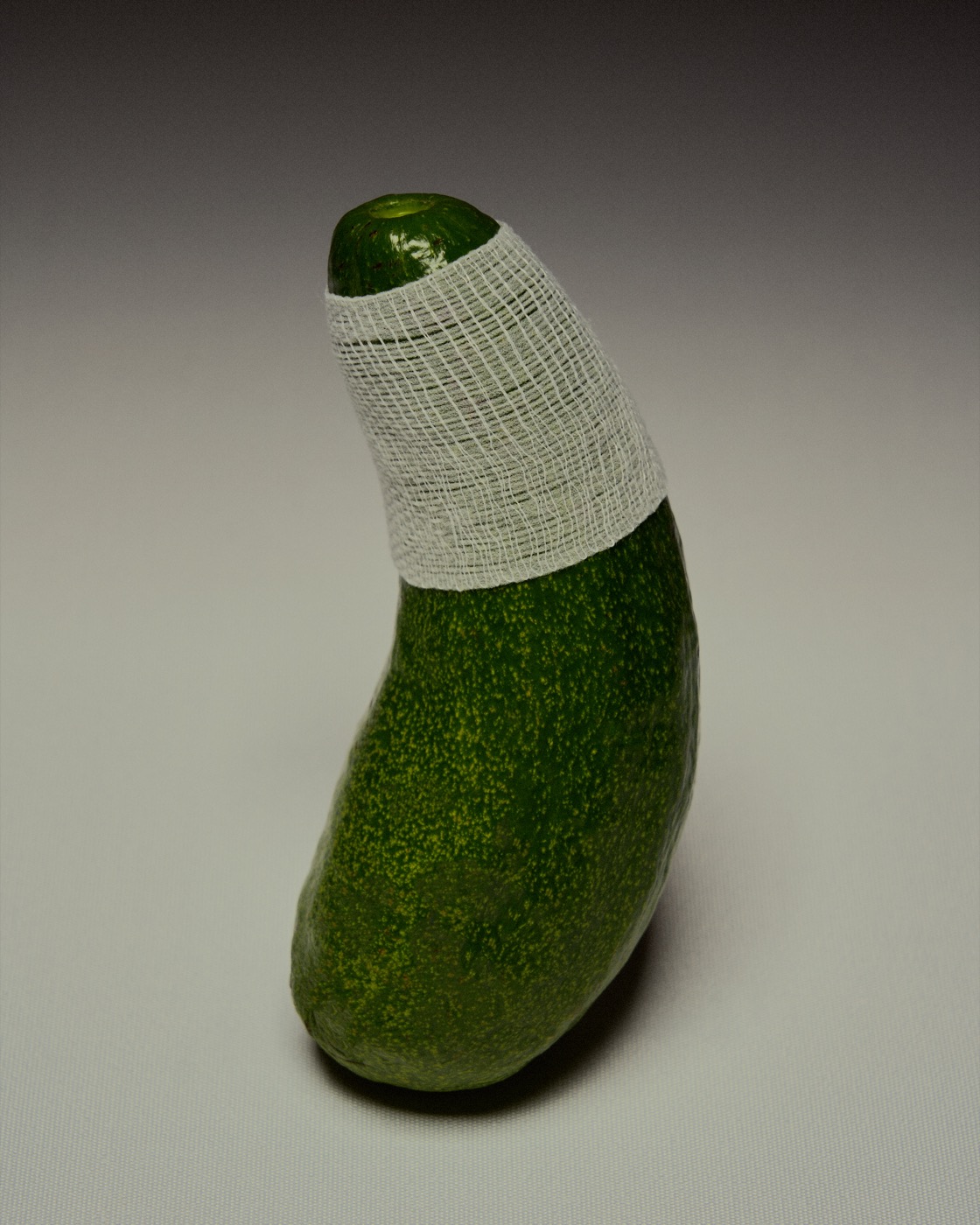
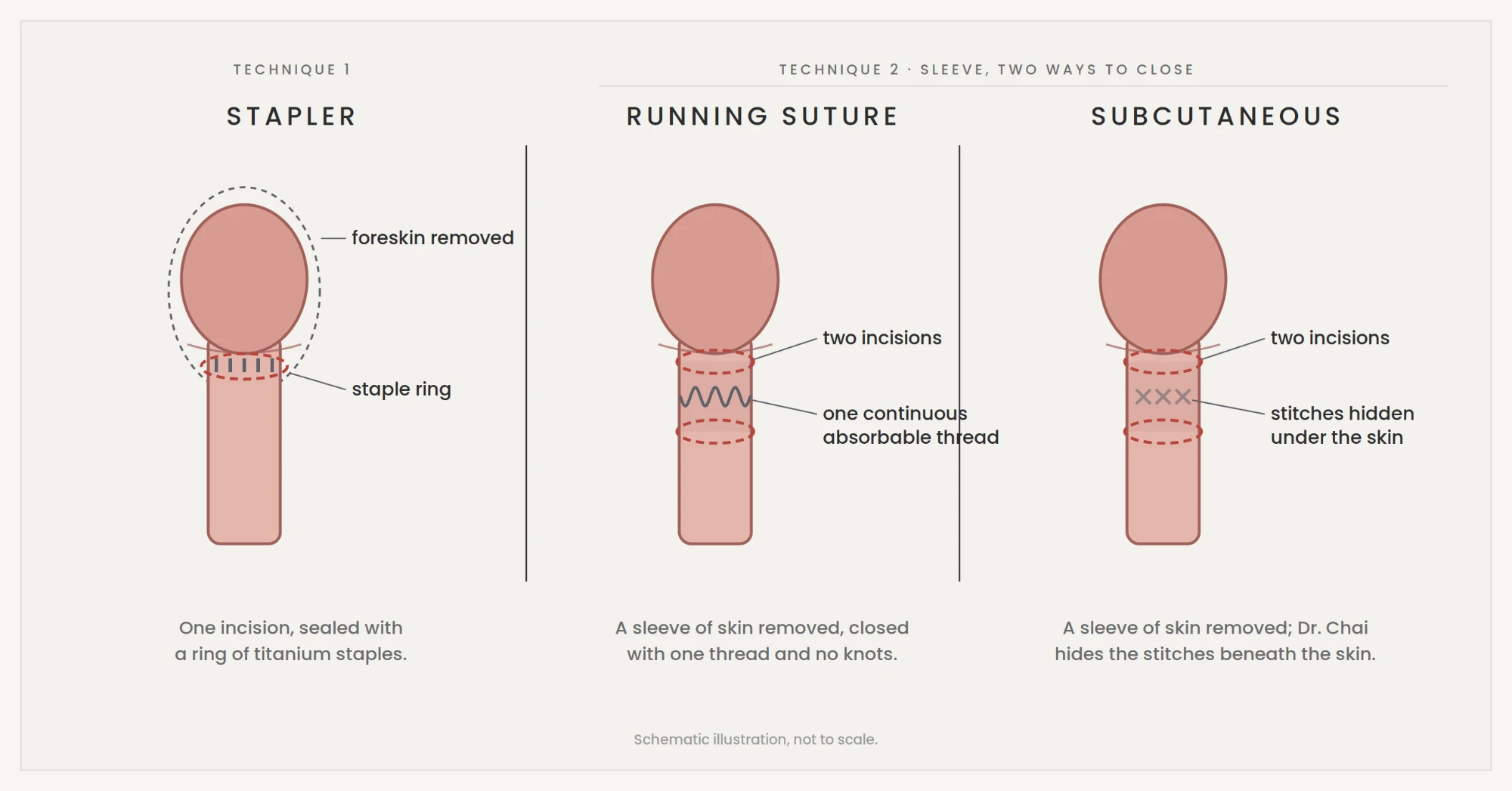
There are two main types of circumcision for adults at MENHANCE: stapler circumcision and sleeve circumcision. Sleeve circumcision can be closed in two ways, with a Running Suture or with Dr. Chai’s subcutaneous suturing, which gives you three options in total. The foreskin is removed in each, but how the wound is closed affects bleeding, comfort, whether stitches need removing and how the scar looks.
Ask most men what matters in an adult circumcision and they’ll talk about the cut. Ask a urologist, and he’ll talk about the close. At MENHANCE, adult circumcision takes between about 20 minutes and an hour under local anaesthetic, depending on the technique, and most men go home the same day. This guide explains each circumcision technique, what published research says about it, the possible risks, and how to work out which option fits your anatomy and priorities.
Key takeaways
- Two techniques, three finishes: stapler circumcision is the quickest with the least bleeding; sleeve circumcision is closed either with a Running Suture (one absorbable thread, no knots to remove) or with subcutaneous suturing, which hides the stitches beneath the skin for the most refined finish. Both use absorbable sutures, so neither needs stitch removal.
- Recovery is similar for all three: 20 minutes to an hour under local anaesthetic, home the same day, and overall healing of around four weeks, with no sex for 4–6 weeks.
- Low risk, not no risk: complications such as bleeding or infection are uncommon, and high-quality studies show little or no effect on sexual function, although the topic is still debated.
Why Men Choose Adult Circumcision
Medical reasons are common. Phimosis, where the foreskin is too tight to pull back, can make hygiene difficult and erections uncomfortable, and circumcision is a definitive treatment when creams or stretching haven’t helped. Recurrent balanitis, repeated inflammation or infection of the head of the penis, is another frequent reason, and circumcision usually stops it recurring.
Health and hygiene motivate many men. Three large randomised trials in Africa showed that circumcision reduces the risk of heterosexual men acquiring HIV (Siegfried et al., 2009), and circumcision is also associated with lower rates of some other sexually transmitted infections and of penile cancer, with the strongest evidence for circumcision in childhood. Everyday hygiene is simpler too. Circumcision doesn’t replace condoms or safer sex, so regular STI screening is still worthwhile.
Appearance and personal preference matter too. Many men simply want a cleaner, more uniform look. Cultural and religious reasons also bring men to circumcision in adulthood.
Whatever your reason, the next decision is which circumcision technique to choose.
The 3 Types of Circumcision at a Glance
| Stapler Circumcision | Sleeve + Running Suture | Sleeve + Subcutaneous Suturing | |
|---|---|---|---|
| Technique | Stapler | Sleeve | Sleeve |
| Time in theatre | About 20 minutes | About 40 minutes | About an hour |
| How it closes | Single-use device cuts and seals at the same time | One continuous absorbable thread instead of individual knots | Stitches hidden beneath the skin |
| Finish | Even, circular line | Flatter, smoother scar line | Barely visible, seamless line |
| Key strength | Quickest procedure, least bleeding | No knots, even tension, no stitch removal | Most refined cosmetic finish |
| Stitch or staple removal | Staples begin to fall off from around week 4; occasionally a few need removing | Not needed — absorbable | Not needed — absorbable, and nothing visible on the surface |
| Best for | Straightforward anatomy, quick recovery | A smooth, natural result with comfortable healing | Appearance as top priority, revisions, complex anatomy |
All three types of circumcision are performed under local anaesthetic, with no overnight stay. The more tailored the closure, the longer the procedure takes: about 20 minutes with the stapler, around 40 minutes for a sleeve with a running suture, and about an hour for a sleeve finished with subcutaneous suturing.
1. Stapler Circumcision: The Quickest Procedure
Stapler circumcision uses a single-use device that removes the foreskin and seals the wound in one step. An inner bell protects the head of the penis (the glans) while an outer bell holds a circular blade and a ring of titanium staples. As the blade cuts, the staples close the edge, controlling bleeding at the same moment and leaving an even, circular line. At MENHANCE it takes about 20 minutes, making it the quickest option.
What the research says
A multicentre randomised trial of 879 adult men compared stapler circumcision with conventional surgery (Jin et al., 2015). With the stapler:
- Average surgery time fell from 24.2 minutes to 6.8 minutes
- Blood loss dropped from 9.4 mL to 1.8 mL
- Pain scores during and after surgery were lower
- Complications occurred in 2.7% of men compared with 7.8%
In that trial the stapler also cost considerably more. A systematic review of nine randomised trials and 1,898 patients supports the same overall picture for device-based circumcision (Huo et al., 2017). Most of these studies were carried out in China, and results can vary between devices and surgeons.
When do circumcision staples fall off?
A dressing check is booked 2–3 days after your procedure. The staples begin to fall off on their own from around the four-week mark, and it can take a little longer for all of them to come away, so it’s worth planning for this rather than expecting them gone within the first month. Gentle washing with soap after day 10 helps them loosen. Occasionally a few need to be removed at a clinic rather than falling away. MENHANCE does this free of charge if you return, or a local clinic can do it, which is reassuring for men flying home after circumcision in Thailand.
Things to consider
The stapler isn’t suitable for every anatomy, and occasionally staples need to be removed rather than falling away. Your urologist will tell you at consultation whether it’s a good fit.
Best for: men with straightforward anatomy who want the quickest procedure, minimal bleeding and a simple procedure.
Sleeve Circumcision: One Technique, Two Ways to Close
Sleeve circumcision uses two precise incisions to remove a measured sleeve of skin, rather than one cut. This allows the result to be tailored closely to your anatomy. The skin edges are then joined in one of two ways, and that choice decides the finish.
2. Sleeve With Running Suture: Seamless Finish With Continuous Absorbable Stitching
The Running Suture Sleeve combines precise sleeve resection with a single, continuous absorbable thread. Instead of tying a knot at every stitch, one thread runs around the wound line. At MENHANCE this takes around 40 minutes, because the sleeve is measured and resected precisely before the wound is closed. Removing those individual knots is what gives a flatter, smoother and more natural finish once healed, which is why this approach is sometimes called knotless circumcision.
Why knots matter
Traditional circumcision closure uses interrupted stitches: a row of separate stitches, each tied off with its own knot. Every knot is a small raised point on the scar line and a spot where irritation, infection or a suture granuloma (a small inflammatory lump around a stitch) can develop. Running suture circumcision removes that row of knots.
The 4 benefits of the Running Suture Sleeve
- A seamless cosmetic finish. Without individual knots along the wound, the technique helps prevent hard skin puckering and raised knots along the scar line.
- Balanced tension around the shaft. A continuous thread spreads skin tension evenly around the penis rather than concentrating it at each knot. This is designed to reduce localised swelling and the tight feeling some men notice after surgery.
- A tailored aesthetic line. Precise skin measuring during sleeve resection preserves natural proportions and places the incision line discreetly.
- Comfortable healing with nothing to remove. Medical-grade absorbable sutures dissolve naturally, so there are no stitches to take out.
What the research says
One of the few studies comparing continuous and interrupted closure in adult circumcision followed 250 men at a tertiary hospital in southern India. With continuous absorbable sutures:
- Surgery took 14 minutes on average, compared with 45 minutes with interrupted stitches
- Wounds healed in about 6 days, compared with 13
- Wound infections and suture granulomas were significantly less common
The study reviewed past cases rather than randomising patients, so it suggests a trend rather than proving it. Operating times in a study compare techniques within one hospital and don’t transfer between clinics, since each surgeon works at their own pace. It is consistent with wider surgical evidence: a meta-analysis of randomised trials in skin surgery found wounds were significantly less likely to reopen after continuous suturing than after interrupted stitching (Luo et al., 2023).
Best for: men who want a smooth, natural-looking result, even tension for a more comfortable recovery, and no stitches to remove.
3. Sleeve With Subcutaneous Suturing: Dr. Chai’s Signature Technique
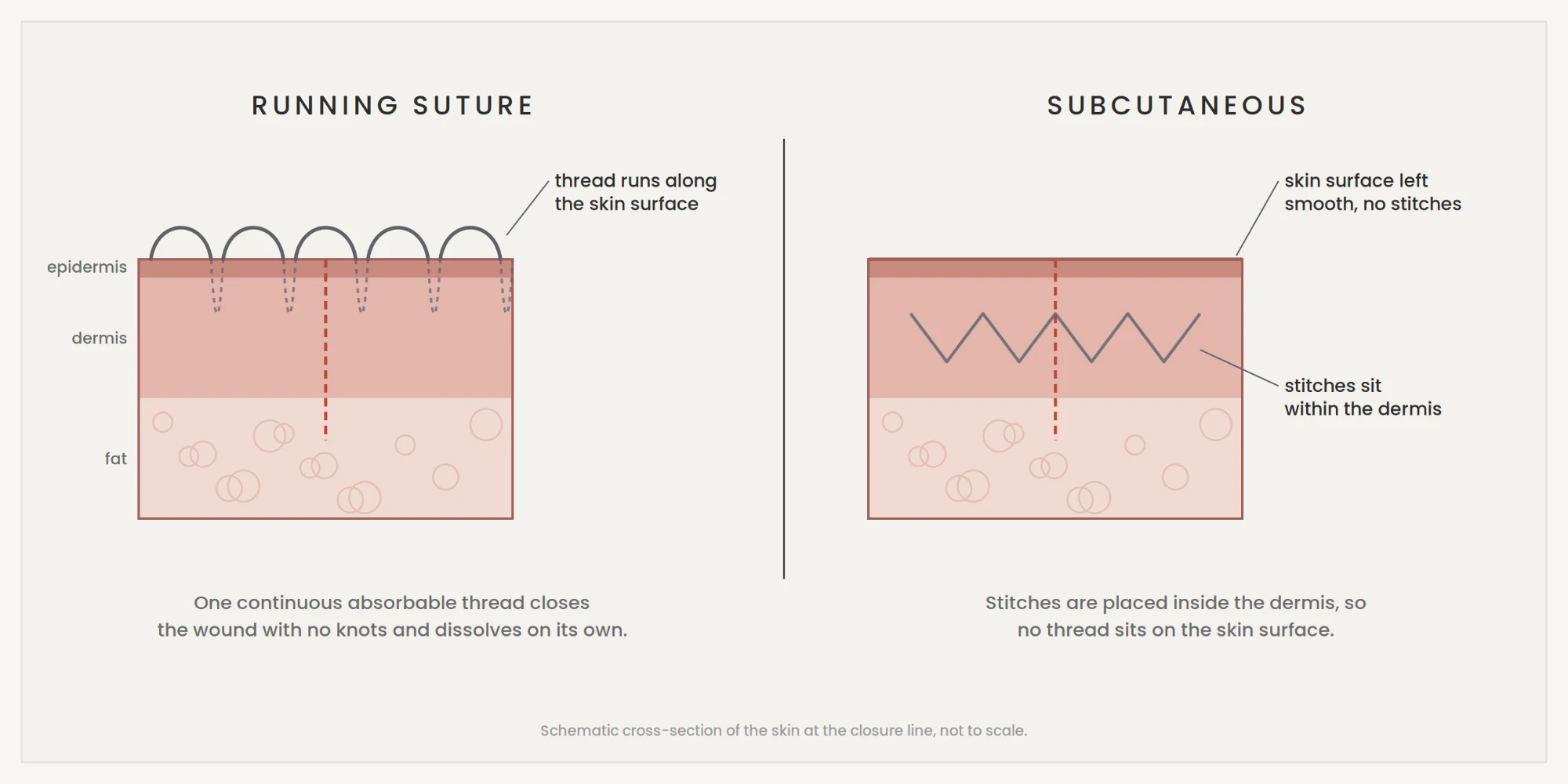
This is the most refined cosmetic finish MENHANCE offers, and the technique men choose when the result matters most to them. After precise sleeve resection, Dr. Chai closes the wound with subcutaneous suturing, burying the stitches beneath the surface, inside the dermis. The sutures are absorbable, so there is nothing to remove later. The procedure takes about an hour, roughly three times as long as the stapler.
Because the thread sits under the skin, there is no visible row of stitches on the surface. The skin edges meet cleanly and typically heal smooth and flat, leaving a barely visible line.
What makes the signature technique different
- Nothing on the surface, and nothing to remove. The sutures dissolve on their own, so there is no return visit for stitch removal.
- Nothing showing while you heal. With surface stitching, thread sits on the skin during recovery, and stitches that pass through the skin can leave small marks along the scar line. Placing the stitches within the dermis avoids both, so the healing line stays clean from the start.
- A result tailored to you. Two precise incisions let Dr. Chai decide exactly how much skin to remove and where the line will sit, preserving natural proportions.
- Performed by a senior urologist. Dr. Chai has 30 years’ experience in urology, including 13 years at Samitivej Hospital, and operates in MENHANCE’s own licensed operating room. The doctor who consults with you is the one who operates and the one who reviews you afterwards.
- The approach used when precision matters most. It is the technique of choice for revising a previous circumcision and for anatomy that needs the most customised approach.
Why it’s the premium option
Placing stitches inside the skin is more technically demanding and takes more surgical time than stapling or surface stitching: about an hour in theatre, against roughly 40 minutes for a running suture and 20 minutes for the stapler. What you invest in is precision, the surgeon’s experience, and a finish designed to be as discreet as possible. A circumcision scar is permanent, so many men prefer to invest in the finish once.
How it differs from the Running Suture Sleeve
Both techniques begin with precise sleeve resection. The difference is where the thread sits. In the Running Suture Sleeve, a continuous thread runs along the wound line. With subcutaneous suturing, the stitches are placed under the skin, so nothing is visible on the surface.
What the research says
Stitches placed inside the skin are called subcuticular sutures. In the same skin-closure meta-analysis, subcuticular continuous sutures received higher cosmetic ratings from both patients and doctors than interrupted stitches (Luo et al., 2023). Those trials covered skin surgery in general rather than circumcision specifically, so they support the principle rather than proving the result for circumcision.
When this technique makes most sense
- The cosmetic result is your top priority
- You need a revision of a previous circumcision
- Your anatomy benefits from the most tailored approach
Best for: men who want the most discreet, natural-looking circumcision scar, and who see the finish as worth investing in.
Does Circumcision Reduce Sensitivity or Sexual Pleasure?
It’s a question many men want answered but hesitate to ask. The research is largely reassuring, though not entirely one-sided.
A large systematic review analysed 94 publications and concluded that the highest-quality studies show circumcision has minimal or no adverse effect on sexual function, sensation, satisfaction or pleasure, with some studies finding benefits, including in men circumcised as adults (Morris & Krieger, 2020).
A Danish systematic review of 38 studies reached a similar overall conclusion. The only consistent differences in circumcised men were less premature ejaculation and increased penile sensitivity. After circumcision for medical reasons, most outcomes were comparable, although difficulty reaching orgasm was reported more often on lower-grade evidence, and findings on erectile function were inconsistent (Shabanzadeh et al., 2016).
This remains a debated area, and some researchers dispute these conclusions, so individual experience can vary. In the first few weeks, many men find the head of the penis feels more sensitive as it adjusts to being uncovered; this usually settles as healing progresses.
If you’re having circumcision for a medical reason, talk through realistic expectations at your consultation. If ejaculatory control is a separate concern, ask about premature ejaculation treatment at the same visit.
Circumcision Risks and Possible Complications
Adult circumcision is a well-established, low-risk procedure, but like any surgery it isn’t risk-free. Possible complications include:
- Bleeding or a haematoma (a collection of blood under the skin)
- Infection of the wound
- Swelling, which is common in the first days and usually settles
- Wound separation, where part of the wound edge opens before it has healed
- Reactions to stitches, such as a small suture granuloma
- Retained staples after stapler circumcision, which may need removing
- Cosmetic concerns, such as uneven skin or too much or too little skin removed, occasionally needing a revision
- A reaction to the local anaesthetic, which is rare
Who needs extra assessment before circumcision
Tell your doctor if you:
- have a bleeding disorder
- take blood thinners (including aspirin or supplements that affect bleeding)
- have diabetes
- have an active genital infection or skin condition
- have had previous penile surgery
These don’t always rule circumcision out, but they may change the timing, technique or aftercare.
When to contact your doctor after circumcision
Seek medical advice promptly if you notice:
- Bleeding that doesn’t stop after 10–15 minutes of firm, gentle pressure
- A fever, or spreading redness, pus or a foul smell from the wound
- Pain that is getting worse rather than better
- Difficulty passing urine, or being unable to pass urine
Which Type of Circumcision Is Best for You?
There’s no single best circumcision method for adults, only the best match for your anatomy and priorities.
Choose the stapler if speed and minimal bleeding matter most, and your anatomy is straightforward.
Choose sleeve with a running suture if you want a smooth, natural finish without raised knots, even tension for a more comfortable recovery, and no stitches to remove.
Choose sleeve with subcutaneous suturing if appearance matters most to you and you want the most discreet, refined result, performed by a senior urologist. It is also the choice for revisions and anatomy that benefits from the most customised approach.
Your urologist examines you and recommends the technique at consultation. If a tight or short frenulum is the main problem rather than the foreskin itself, a frenuloplasty may be a less extensive alternative.
What Happens on the Day
- Consultation and planning. Your urologist examines your anatomy, reviews your health and medicines, and confirms the technique.
- Local anaesthetic. The area is cleaned and numbed. You stay awake without general anaesthesia, and a Penthrox inhaler is available for extra comfort.
- The procedure. The foreskin is removed and the wound closed using your chosen method, taking about 20 minutes with the stapler and up to an hour with subcutaneous suturing.
- Dressing and aftercare. A light dressing is applied, and you leave with prescribed ointment, pain relief and clear instructions.
- Home the same day. A follow-up check supports safe healing.
How Long Does Circumcision Take to Heal?
Overall circumcision recovery time is around four weeks. With the stapler, allow a little longer for the staples themselves, which begin to fall off from around week 4. Always follow the specific instructions your doctor gives you, as aftercare can vary with technique. A typical timeline:
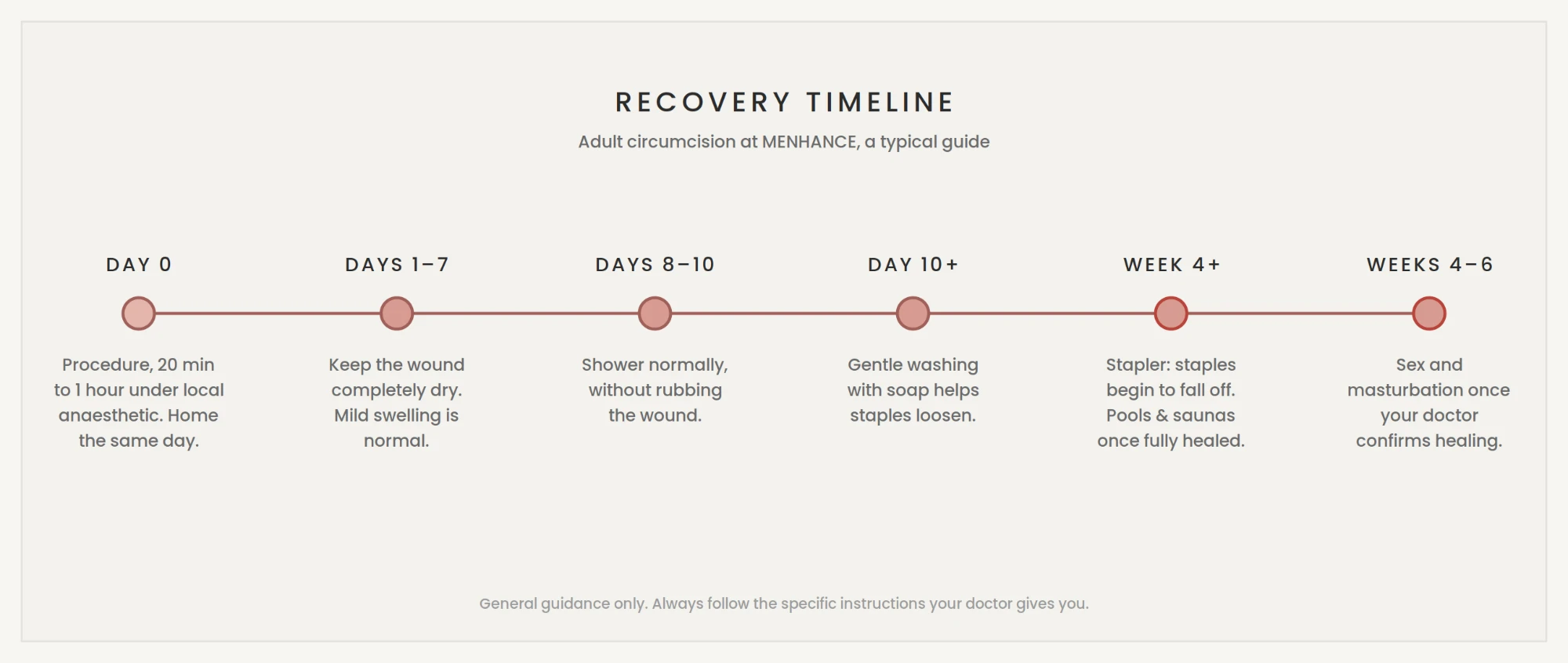
- Days 1–7: Keep the wound completely dry. Mild swelling and tenderness are normal.
- Days 8–10: Shower normally, but don’t rub the wound.
- After day 10: Gentle washing with soap helps staples loosen ahead of falling off.
- From around week 4: Staples begin to fall off. Keep avoiding swimming pools, baths, hot tubs and saunas until you’re fully healed.
Most men return to light daily activities within days. Wear loose clothing and avoid heavy lifting and strenuous exercise until healed. Night-time erections can be uncomfortable in the first week or two; this is normal and eases as the wound heals.
When can I have sex after circumcision?
Avoid intercourse and masturbation for 4–6 weeks, or until your doctor confirms you’ve healed. Returning too early risks reopening the wound and setting recovery back.
Adult Circumcision in Thailand at MENHANCE
About the surgeon
Dr. Teanchai Siricharoensang (“Dr. Chai”) · Board-certified urologist · Thai medical licence No. 14396
30 years’ experience in urology, including 13 years at Samitivej Hospital. MD from Siriraj Medical School. Member of the Thai Urological Association and the American Urological Association. Dr. Chai leads circumcision at MENHANCE, and the subcutaneous finish is his signature technique. Meet our doctors
Treatment takes place in a calm, fully private clinical setting, with confidential care at all three clinics.
Circumcision cost in Bangkok, Phuket and Pattaya
Circumcision at MENHANCE starts from ฿22,000, with your technique and final price confirmed at consultation. It’s available at our clinics in Bangkok (RQ49 Mall, Sukhumvit 49), Phuket (Boat Galleria, Choeng Thale) and Pattaya.
Considering a silicone sheet implant for penile enlargement as well? The implant requires circumcision first, so it’s worth planning both together with your urologist.
Ready to talk it through?
- Book a free, confidential consultation to have your anatomy assessed and the right type of circumcision recommended.
- Message the team on WhatsApp at +66 97 168 4448.
- International patients can start with an online consultation.
Frequently Asked Questions
What are the different types of circumcision?
MENHANCE offers two circumcision techniques. Stapler circumcision cuts and seals with a single-use device. Sleeve circumcision removes a precisely measured sleeve of skin and is closed in one of two ways: a Running Suture, using one continuous absorbable thread with no knots, or Dr. Chai’s subcutaneous suturing, where the stitches are hidden beneath the skin.
What is the best circumcision method for adults?
There is no single best method. Stapler circumcision is the quickest procedure with the least bleeding, the Running Suture Sleeve gives a smooth finish with absorbable stitches, and sleeve circumcision with subcutaneous suturing gives the most refined cosmetic result, also with nothing to remove. A urologist recommends the right technique after examining your anatomy.
What is running suture circumcision?
Running suture circumcision is a sleeve circumcision closed with a single continuous absorbable thread rather than separately knotted stitches. Removing the knots gives a flatter, smoother scar line, spreads skin tension evenly around the shaft and means there are no stitches to remove.
What is sleeve circumcision?
Sleeve circumcision uses two precise incisions to remove a sleeve of foreskin, allowing the result to be tailored closely to your anatomy. At MENHANCE it is closed either with a continuous absorbable running suture or with hidden subcutaneous stitches.
How long does a circumcision procedure take?
It depends on the technique. Stapler circumcision takes about 20 minutes, a sleeve circumcision closed with a running suture takes around 40 minutes, and a sleeve finished with subcutaneous suturing takes about an hour. All three are done under local anaesthetic, and you go home the same day.
Do circumcision stitches need to be removed?
No. Both sleeve closures at MENHANCE use absorbable sutures that dissolve naturally, whether the wound is closed with a running suture or with hidden subcutaneous stitches, so there is nothing to take out. With stapler circumcision, the staples begin to fall off on their own from around the four-week mark; occasionally a few need to be removed at a clinic instead.
Is stapler circumcision better than stitches?
In a large randomised trial, stapler circumcision was faster, caused less bleeding and had fewer complications than conventional surgery, although it cost more. Stitched sleeve techniques allow more customisation and a finer cosmetic finish. The right choice depends on your anatomy and priorities.
Which circumcision leaves the least visible scar?
Sleeve circumcision with subcutaneous suturing places the stitches beneath the skin, so there is no visible row of stitches and the area typically heals to a smooth, barely visible line. The Running Suture Sleeve also gives a flatter, smoother line than traditional knotted stitching. Healing varies between individuals.
What are the risks of adult circumcision?
Adult circumcision is a well-established, low-risk procedure. Possible complications include bleeding, infection, swelling, wound separation, reactions to stitches, retained staples, dissatisfaction with the cosmetic result and, rarely, the need for revision surgery. Serious complications are uncommon.
Why does subcutaneous suturing cost more?
Placing the stitches inside the skin, rather than through its surface, is more technically demanding and takes more surgical time. It is performed by Dr. Chai, a senior urologist with 30 years’ experience, and gives the most refined cosmetic finish MENHANCE offers. Because a circumcision scar is permanent, many men prefer to invest in the finish once.
Is adult circumcision painful?
Adult circumcision is done under local anaesthetic, so you are awake but the area is numb. Mild tenderness and swelling in the first few days are normal and are managed with prescribed pain relief.
How much does circumcision cost in Thailand?
At MENHANCE, adult circumcision starts from ฿22,000. The final price depends on the technique recommended at your consultation.
Can I fly home after circumcision in Thailand?
Many international patients do. Both sleeve closures use absorbable stitches that dissolve on their own, and stapler staples begin to fall off from around four weeks; occasionally a few need removing, which a local clinic at home can do. Discuss your travel dates with your doctor before booking.
References
- Jin XD, et al. Adult male circumcision with a circular stapler versus conventional circumcision: a prospective randomized clinical trial. Braz J Med Biol Res. 2015;48:577–582. PMID: 25831203
- Huo ZC, et al. Use of a disposable circumcision suture device versus conventional circumcision: a systematic review and meta-analysis. Asian J Androl. 2017;19(3):362–367. PMID: 26975486
- Outcome analysis of continuous versus interrupted sutures for adult circumcision at a tertiary care centre, Tamil Nadu, India. 2022. DOAJ record
- Luo W, et al. Comparing running vs interrupted sutures for skin closure: a systematic review and meta-analysis. Int Wound J. 2023. PMID: 35715955
- Morris BJ, Krieger JN. The contrasting evidence concerning the effect of male circumcision on sexual function, sensation, and pleasure: a systematic review. Sex Med. 2020;8(4):577–598. PMID: 33008776
- Shabanzadeh DM, Düring S, Frimodt-Møller C. Male circumcision does not result in inferior perceived male sexual function: a systematic review. Dan Med J. 2016;63(7):A5245. PMID: 27399981
- Siegfried N, Muller M, Deeks JJ, Volmink J. Male circumcision for prevention of heterosexual acquisition of HIV in men. Cochrane Database Syst Rev. 2009;(2):CD003362. Cochrane summary
Medical disclaimer: this article is for general information only and does not replace personal medical advice. Whether circumcision is suitable for you, which technique is recommended and the expected results depend on an in-person assessment by a qualified doctor. Individual results and recovery vary. If you have urgent symptoms after surgery, seek medical care promptly.
Consult Dr. K
Every case is different. A consultation gives you a plan based on your own assessment.
Book a Free Consultation with Dr. K